
The AI-Fueled Series A Mirage

If you're a venture-backed founder, the 2026 Q3 PitchBook data seems encouraging at first glance. Be careful. Dig a little deeper.
The headline data shows that VCs invested $515 billion through September 30. That's 60% more than what was deployed throughout all of 2025.
Median Series A deal size is $17.4 million YTD, an increase of 27% from 2025 and up 74% from 2021. Median pre-money valuation is $60 million, an increase of 25% from 2025 and up nearly 80% from 2021.
But all of these numbers are distorted by the surge of investment into AI startups.
Artificial intelligence represents 83% of all venture investment in 2026. The average size of an AI startup round this year is $80 million.
When you separate AI from the rest of the market, the picture flips completely.
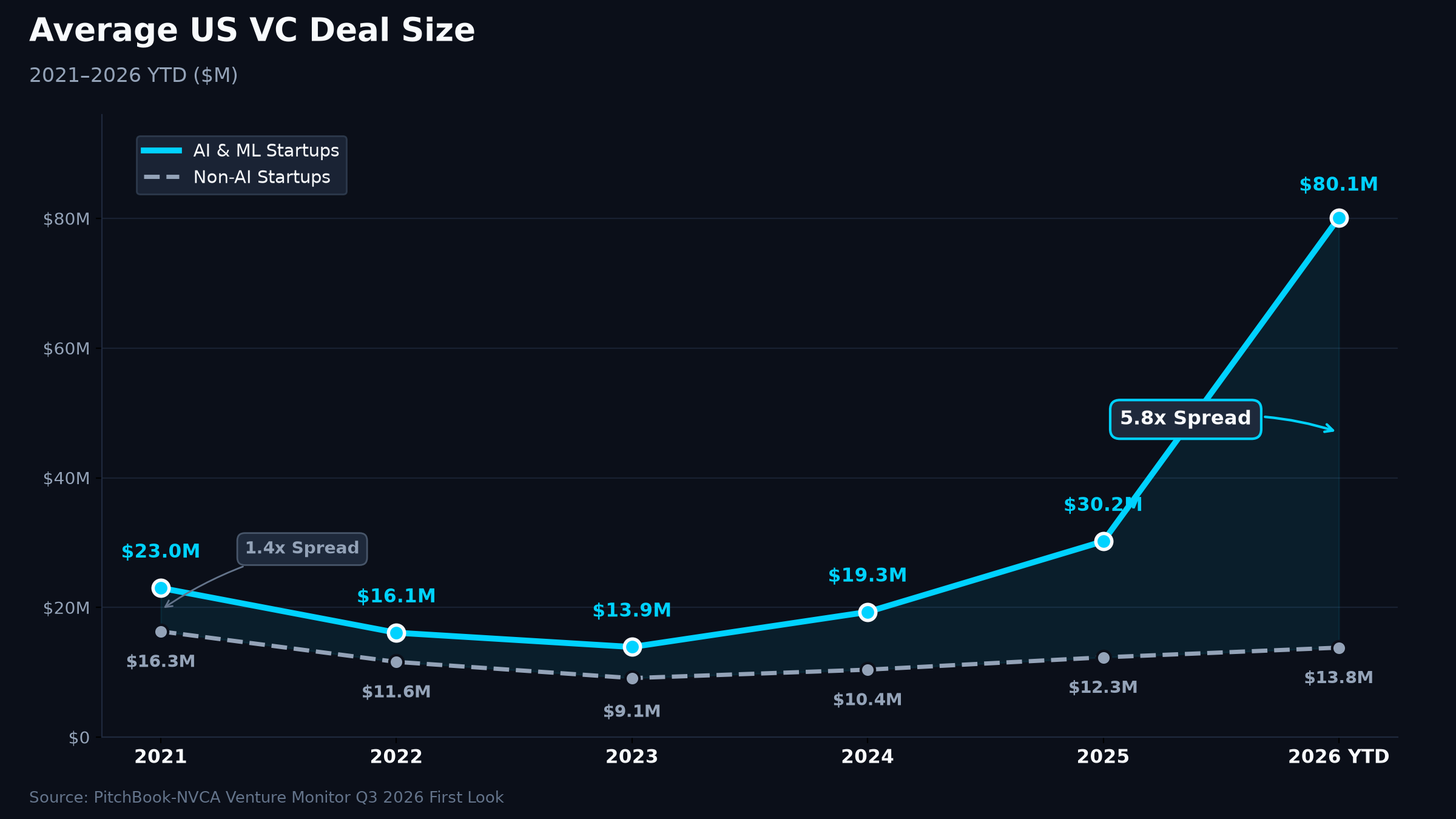
The average size of a non-AI round is $13.8 million. That's a 5.8x spread in deal size. On an annualized basis, the total number of deals and the amount of money invested in non-AI startups has been essentially flat since 2023.
If your startup doesn't have an AI thesis at its core, venture capital is not booming.
This puts founders in a real bind. In a market where non-AI deal volume has stagnated, pitching pure SaaS gets you zero partner meetings.
Pitching an "AI-native" agent narrative places your startup right in the middle of this accelerating valuation trap.
Perhaps you close that Series A at that $60 million median valuation. You celebrate the low dilution.
Here is what happens in year two.
Today's median Series B pre-money valuation is $187 million on a $40 million check. Series B valuations have also nearly doubled since 2021. To command that valuation at today's disciplined 10x SaaS multiple, you need nearly $20 million in ARR.
Here's the other challenge. Your 80% software gross margins just collapsed to 55% because every customer query triggers an expensive API bill to OpenAI or Anthropic sitting directly inside your COGS. Growth-stage investors do not value a 55% margin business at 10x revenue. They price you like tech-enabled services at 4x or 5x.
Now, to clear your Series B hurdle, you do not need $20 million in ARR. You need $40 million. In eighteen months. On a $15 million Series A balance sheet. That is an incredibly steep hill to climb.
Investors are playing a different game. They are driven by power-law math and can hedge across a portfolio of startups. You only have one.
If you're raising with an AI thesis, close the round and take the check.
But treat that $60 million valuation as an operational liability, not an achievement. Build a path to Default Alive on your Series A cash if you can. Be clear about those Series B metrics. Be prepared to pivot, even if that means pursuing a sale, while you have enough runway to do so successfully.
Take charge of your startup's destiny.
Take Charge of Your Startup's Destiny
You don't have to navigate your hardest inflection points alone. I partner with founders to bridge the gap between vision and execution.